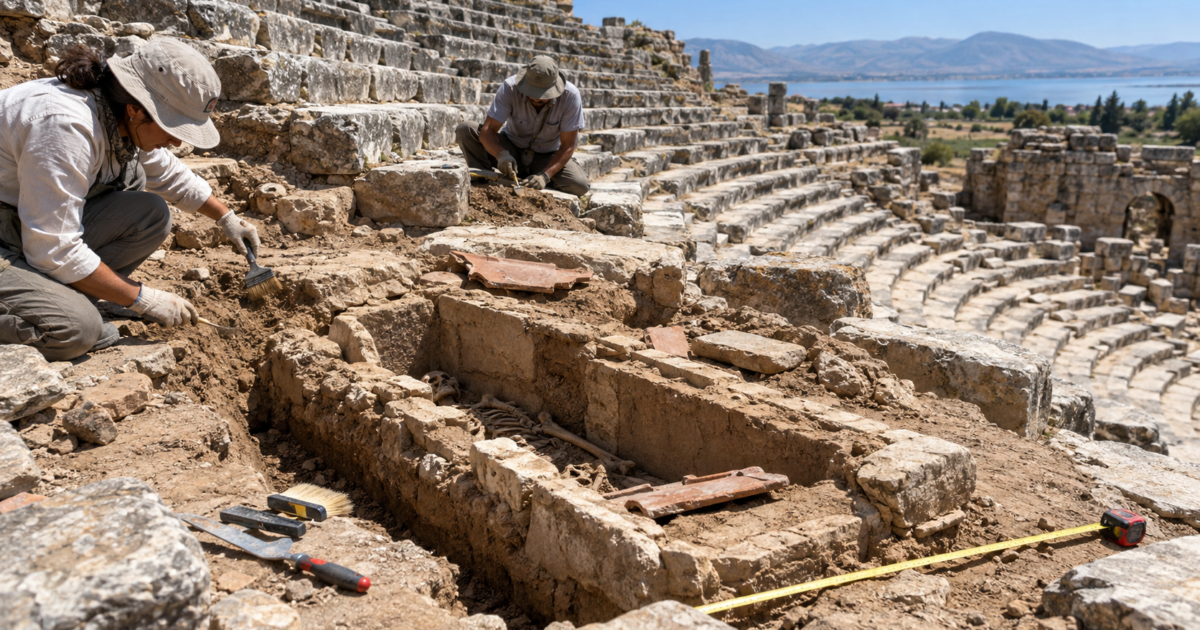
Archaeologists have discovered a mysterious tomb estimated to be roughly 2,000 years old among the spectator seats of an ancient theater in Gölyazı, northwestern Turkey.
Researchers don’t know whose remains were buried there or why the burial was placed in such an unusual location. The theater belonged to the ancient city of Apollonia ad Rhyndacum, which already had a designated cemetery.
The tomb was discovered in the northern section of the theater’s lower spectator seating area. The ancient theater is believed to have accommodated approximately 5,000 spectators and included VIP seating and box-like sections. The human remains found were cremated, and it’s not clear how many individuals were buried there.
While experts are stumped as to why a tomb would be located in an ancient theater, this writer speculates that perhaps the people whose remains were found in the tomb were avid theatergoers who simply did not want to have to give up their theater seats because their lives had concluded.
Excavation director Professor Derya Şahin discussed the mysterious discovery in an October 28 interview with Anadolu Agency. Her comments have been translated from Turkish.
“This year, we came across an interesting grave with a mudbrick burial enclosure and terracotta roof tiles. It was an interesting find. Why was there a burial structure here? That was a big question mark. At the same time, it excited us. We are trying to resolve these questions. Of course, we will need to conduct extensive library research. Our most important discovery this year was a tomb with a mudbrick burial enclosure in the northern section of the theater’s lower seating area. It dates to the first century.”
“In terms of its structure, the tomb is exactly like the other graves we know here. It has the same characteristics. But when an ancient city already had a necropolis, what was a tomb doing in the theater? This excited us very much. The tomb must have been special, must have meant something, and must have carried some trace of sacred or heroic significance.”
“It’s not really possible to determine the number of people from the bones. Because the remains were cremated, they don’t yield much evidence.”
Local authorities plan to restore the theater for cultural and artistic events, meaning that perhaps one day more people will decide to be buried in it as well.