It’s possible the mystery of Amelia Earhart’s disappearance could be solved soon.
Eighty-nine years after the famous aviator and her navigator, Fred Noonan, vanished over the Pacific Ocean, researchers backed by Purdue University are expected to provide an update by Saturday, October 17, on a mysterious underwater object that could be the remains of Earhart’s missing aircraft.
Earhart and Noonan disappeared on July 2, 1937, while attempting to fly around the world. Their aircraft never reached its intended refueling stop at Howland Island, and neither the plane nor its occupants were ever found.
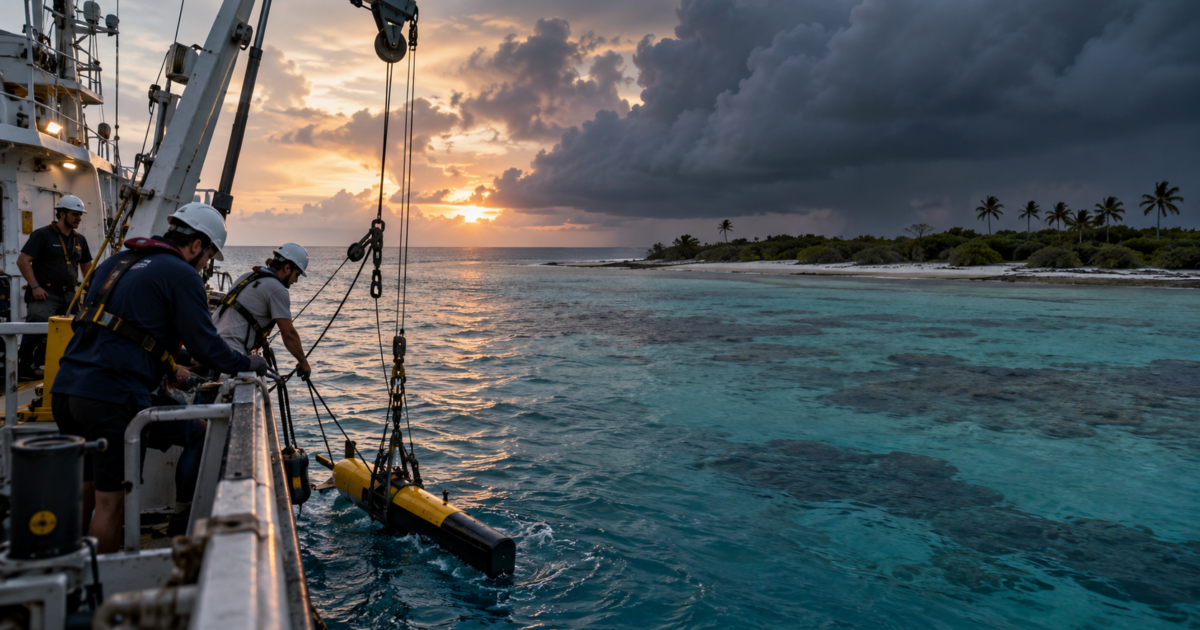
The expedition is investigating the Taraia Object, a formation first spotted in satellite imagery in 2020 and subsequently identified in aerial photographs dating back to 1938. Expedition organizers believe the object could be the fuselage and tail section of Amelia Earhart’s Lockheed Electra 10-E.
It lies in a lagoon off Nikumaroro, where some researchers believe Earhart and Noonan may have landed.
Speaking ahead of the expedition, Archaeological Legacy Institute executive director Rick Pettigrew told Purdue University:
“With just a week to go before the launch of our expedition, my conscious focus is on the execution of our fieldwork plan,” he said. “Inevitably, though, this comes with an array of strong feelings. I’m intensely and eternally grateful to the many individuals and organizations who have helped to make our vision real. I feel truly lucky to be in a position to possibly solve one of the greatest mysteries of all time, whether or not that happens.”
“Finding Amelia Earhart’s Electra aircraft would be the discovery of a lifetime,” Pettigrew continued. “Other evidence already collected by The International Group for Historic Aircraft Recovery establishes an extremely persuasive, multifaceted case that the final destination for Earhart and her navigator Fred Noonan was on Nikumaroro. Confirming the plane wreckage there would be the smoking-gun proof.”
The 17-person expedition began examining the lagoon Wednesday, October 14, using sonar and magnetometers. However, severe weather prevented researchers from reaching the island Thursday. Purdue announced that two days of fieldwork remain, during which researchers hope to expose the object and determine what it is. An update is expected within 48 hours.