Researchers have developed a new strategy in their search for signs of alien life.
Astronomers have long been scouring space for radio signals that could be evidence of technology created by an intelligent civilization. However, the search has yet to produce a confirmed signal from extraterrestrial technology.
In a paper announced on November 3, the SETI Institute revealed that researchers had recorded approximately 1.9 million radio signal detections during a three-night pilot study in the summer of 2023. However, none was evidence of alien life. Instead, the detections could be explained by human-made radio interference, including satellites and radio transmissions.
The lack of evidence of intelligent extraterrestrial civilizations raises questions associated with the Fermi paradox. If intelligent alien civilizations are likely to exist, where are they? Why haven’t we found evidence of them? Why aren’t their radio signals drifting through space?
Now, the SETI Institute is asking a different question. Not where we should be looking for signs of alien life, but when.
The institute is using a concept from game theory known as a Schelling point, named after American economist Thomas Schelling. A Schelling point is a solution to a problem that would appear obvious to two parties who need to coordinate but are unable to communicate with each other.
For example, if you and a friend agreed to meet in New York City but hadn’t decided on a time or location, you might both independently select Grand Central Terminal at noon, recognizing it as a common meeting place and time.
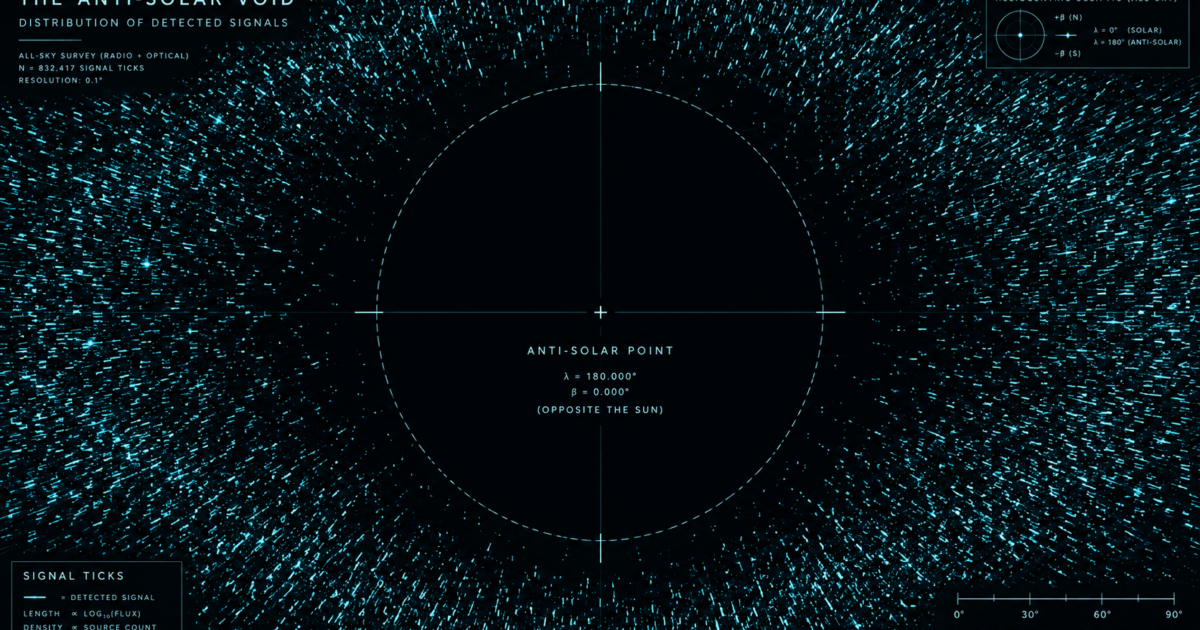
To apply this theory to the search for alien civilizations, researchers need to determine when would be the obvious time for aliens to attempt making contact with us. The SETI Institute believes this could be when an alien civilization observes Earth passing in front of the Sun. From Earth’s perspective, the potential transmitter would appear at the anti-solar point, directly opposite the Sun.
The theory is that an alien civilization observing Earth passing in front of the Sun might recognize this alignment as an ideal time to send us a message, so that’s when and where we should be looking.
The SETI Institute is conducting an approximately four-year search using the Allen Telescope Array in Northern California to listen for signals from the anti-solar point two to three nights per week.
SETI Institute researcher Sofia Sheikh recently discussed the work with the CBC.
“I thought about these ideas that have been percolating for a long time in the literature,” said Sheikh. “And so now the anti-solar point idea is sort of finally getting its time in the sun.”
Sheikh says that researchers are looking for a message from alien life that might simply translate to something like, “We are here.”
“Maybe there is information contained in it, or maybe the signal that we find is what we’d call a carrier wave. So the air horn, that says, ‘Hey, there’s something interesting here.'”
Professor of astrophysics at the University of Rochester Adam Frank is also searching space for technosignatures of alien life. Frank says the work is finally starting to be taken seriously.
“The giggle factor, which existed through almost my entire career, is gone,” said Frank. “And it never made sense.”